
News
Showing 16 results for Researcher: Takeshi Egami
-
May 4, 2026
1 MIN READ
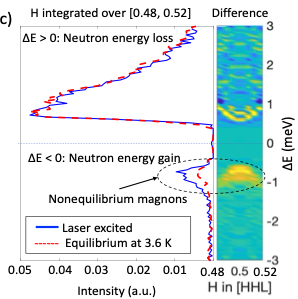
Non-equilibrium magnons revealed by neutrons
Scientific Achievement: Laser pumping combined with inelastic neutron scattering reveals long-living nonequilibrium magnons in a 2D Heisenberg antiferromagnet that break detailed balance in the structure factor and form steady states under periodic driving, analogous to driven dissipative nonequilibrium systems.Significance and Impact: This work opens a previously unexplored frontier: momentum- and energy-resolved studies of dissipative quantum dynamics at milli-electron-volt energy and microsecond time scales.DOI: 10.1038/s41467-026-71068-w

September 17, 2024
8 MIN READ
Materials scientist Egami describes new world order for glasses, liquids
Distinguished materials scientist Takeshi Egami has spent his career revealing the complex atomic structure of metallic glass and other liquids — sometimes sharing theories with initially resistant minds in the scientific community.

April 18, 2024
5 MIN READ
Three ORNL scientists elected AAAS Fellows
Keith Kline, Rigoberto Advincula and Takeshi Egami have been elected fellows of the American Association for the Advancement of Science, the world’s largest general scientific society and publisher of the Science family of journals.
March 11, 2024
1 MIN READ
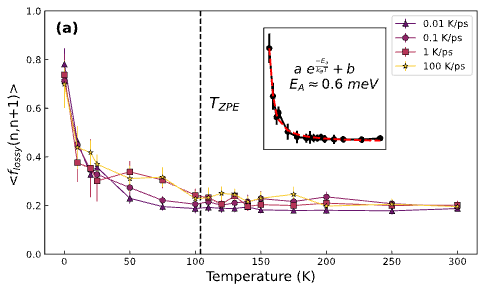
Extreme Fragility of Local Structure of Metallic Glasses
Scientific Achievement: Molecular dynamics (MD) simulations show that the energy barriers separating nearly degenerate states in metallic glasses are low, and easily overcome by quantum fluctuations.Significance and Impact: It is widely assumed that atoms are frozen and immobile in a glass. However, simulation shows atoms are locally moving through thermal and quantum fluctuations.DOI: 10.1038/s41467-024-45640-1
August 26, 2022
1 MIN READ
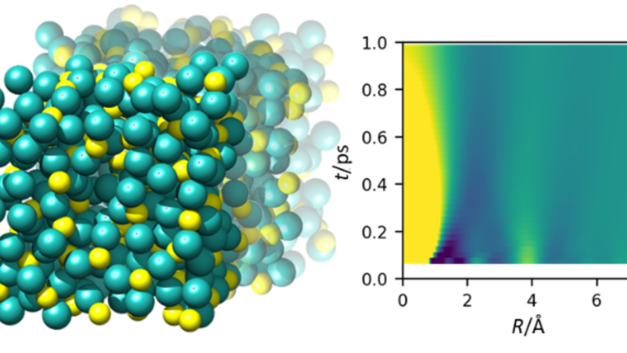
Atomic-scale motion of molten inorganic salts revealed
Scientific Achievement: The atomic-level motion of inorganic molten salts at high temperatures was revealed for the first time using a novel experimental approach to study the real-space dynamic nature of highly disordered liquids.Significance and Impact: This research could revolutionize our fundamental understanding of condensed matter in extreme environments and generate new ways to control their physical properties relevant to emerging carbon-free solar energy storage and nuclear reactor technologies.DOI: 10.1021/acs.jpclett.2c01230
May 2, 2022
1 MIN READ
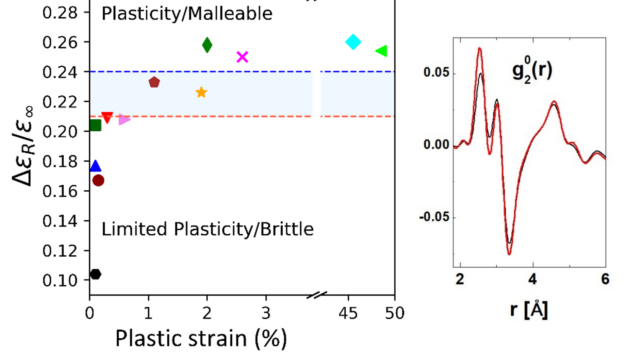
Predicting Ductility of Metallic Glasses by Diffraction
Scientific Achievement: Mechanical ductility of metallic glass can be predicted by x-ray diffraction under stress through structural anisotropy without destructive mechanical testing.Significance and Impact: Metallic glasses are mechanically strong, but often lack ductility, limiting their application. This finding could lead to a better understanding of the origin of ductility, helping the development of more ductile metallic glasses.DOI: 10.1103/PhysRevLett.128.155501
December 7, 2020
1 MIN READ
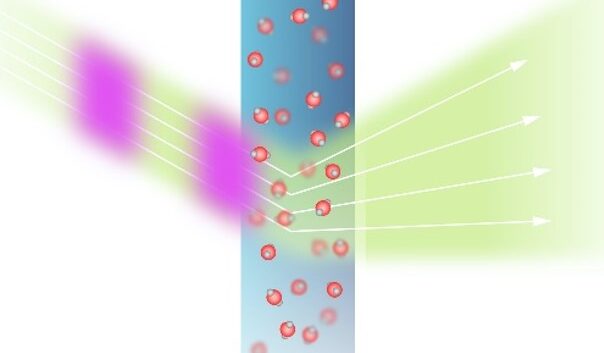
Capturing the correlated motion of water molecules
Scientific Achievement: Researchers revealed atomic-level correlated motion of water molecules at the crucial picosecond timescale to evaluate the dynamic nature of the liquid by using coherent X-ray scattering. Significance and Impact: This research could revolutionize understanding and control of liquid viscosity and conductivity for novel energy technologies, from fuels, lubricants to batteries.DOI: 10.1038/s41467-020-20036-z
April 1, 2020
1 MIN READ
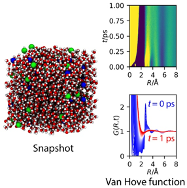
Correlated ion motions in electrolytes seen in real space
Correlated motions of water molecules and salt ions in real space and time were visualized through the Van Hove function.
April 1, 2020
1 MIN READ
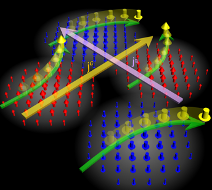
Critical spin fluctuations boost spin currents
New mechanisms for spin Hall effect are theoretically developed based on the critical ferromagnetic fluctuation of magnetic moments.
January 29, 2020
1 MIN READ
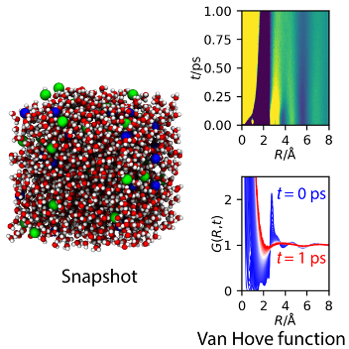
Correlated ion motions in electrolytes seen in real space
Scientific Achievement: Correlated motions of water molecules and salt ions in real space and time were visualized through the Van Hove function.Significance and Impact: Understanding the correlated motions of ions in liquid is a key to improving the mobility of ions in liquid electrolytes in many energy storage devices.DOI: 10.1021/acs.jpclett.9b02891

April 23, 2018
4 MIN READ
Strained materials make cooler superconductors
University of Wisconsin-Madison engineers have added a new dimension to our understanding of why straining a particular group of materials, called Ruddlesden-Popper oxides, tampers with their superconducting properties. The findings, published in the journal Nature Communication...