News

Showing 17 results for Researcher: Ondrej E. Dyck

  • ORNL Placeholder Image

    January 12, 2024

    2 MIN READ

    Researchers demonstrated that stainless steel and other metal alloys coated with hexagonal boron nitride, or hBN, exhibit non-stick or low-friction qualities along with improved long-term protection against harsh corrosion and high-temperature.

  • ORNL Placeholder Image

    June 9, 2023

    1 MIN READ

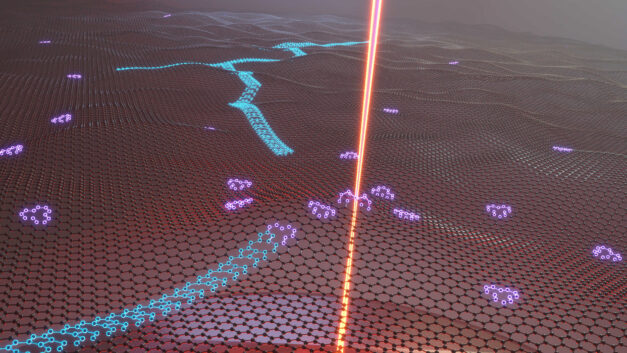
    Scientific Achievement: Using a focused electron beam to direct the positioning of single atoms, researchers are able to directly write complex patterns atom-by-atom into a graphene lattice.Significance and Impact: This achievement sets the stage for new methods for material and device synthesis for quantum information applications as many envisioned quantum devices require individual atoms or defects as qubits.DOI: 10.1021/acs.nanolett.3c00114

  • ORNL Placeholder Image

    February 10, 2023

    1 MIN READ

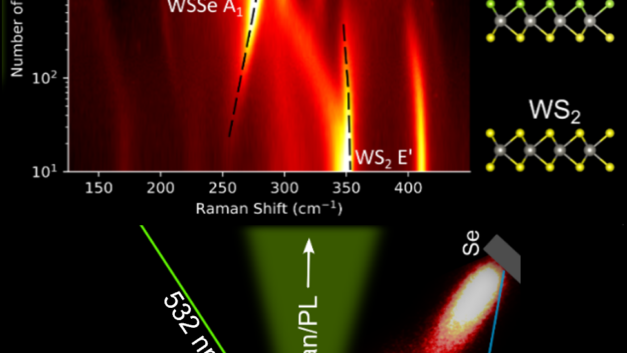
    Scientific Achievement: The kinetic pathways of Janus monolayer formation were revealed by real-time Raman spectroscopy combined with plasma plume diagnostics during pulsed laser deposition (PLD), allowing the capture of 2D metastable alloys.Significance and Impact: This work demonstrates a general in situ diagnostic approach for precision synthesis and real-time adaptive control that are required to enable the autonomous discovery of novel materials and metastable phases.DOI: 10.1021/acsnano.2c09952

  • ORNL Placeholder Image

    December 7, 2022

    1 MIN READ

    Oak Ridge National Laboratory researchers serendipitously discovered when they automated the beam of an electron microscope to precisely drill holes in the atomically thin lattice of graphene, the drilled holes closed up.

  • ORNL Placeholder Image

    April 20, 2022

    2 MIN READ

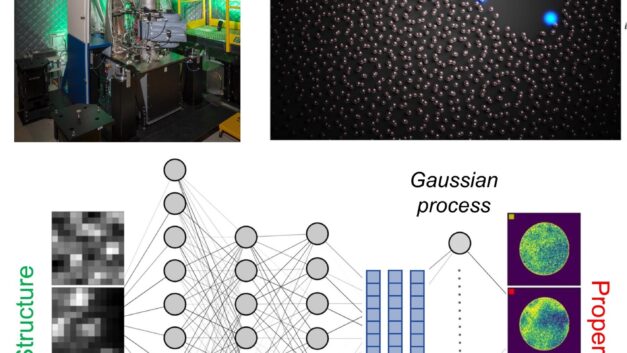
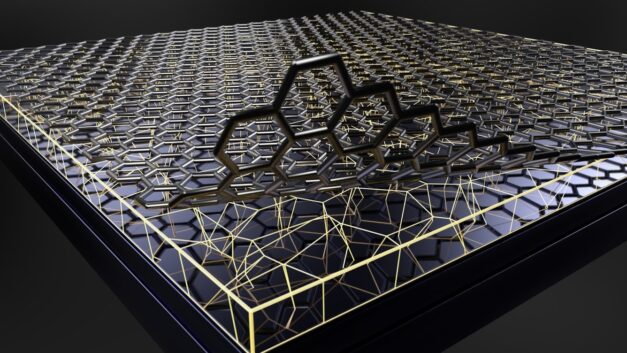
    Automated experiments in Scanning Transmission Electron Microscopy (STEM) are implemented for rapid discovery of local structures, symmetry-breaking distortions, and internal electric and magnetic fields in complex materials. Deep kernel learning enables active learning of the relationship between local structure and a 4D-STEM or electron energy loss spectroscopy based descriptors. With this, efficient and ‘intelligent’ probing of dissimilar structural elements to discover desired physical functionality is made possible. This approach allows effective navigation of the sample in an automated fashion guided by either a pre-determined physical phenomenon, such as strongest electric field magnitude, or in an exploratory fashion. We verify the approach first on pre-acquired data, and further implement it experimentally on an operational STEM. The experimental discovery workflow is demonstrated using graphene, and subsequently extended towards a lesser-known layered 2D van der Waal material, MnPS3. This approach establishes a paradigm for physics-driven automated STEM experiments that enable probing the physics of strongly correlated systems and quantum materials and devices, as well as exploration of beam sensitive materials.

  • ORNL Placeholder Image

    May 10, 2021

    1 MIN READ

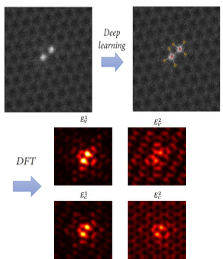
    Scientific Achievement: Demonstrated that structural order parameters and local concentration-driven phase transitions can be described on atomic level from scanning transmission electron microscopy (STEM) data.Significance and Impact: The machine learning approach developed can be used to explore physics of phase transitions and chemical transformations on a single atom level, establishing relationship between local chemical composition, and average electron concentration.DOI: 10.1126/sciadv.abd5084

  • ORNL Placeholder Image

    March 1, 2021

    2 MIN READ

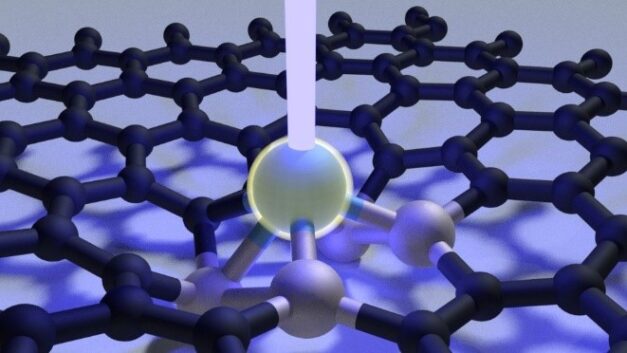
    Oak Ridge National Laboratory scientists demonstrated that an electron microscope can be used to selectively remove carbon atoms from graphene’s atomically thin lattice and stitch transition-metal dopant atoms in their place.

  • ORNL Placeholder Image

    April 2, 2020

    1 MIN READ

    Scientists at Oak Ridge National Laboratory used a focused beam of electrons to stitch platinum-silicon molecules into graphene, marking the first deliberate insertion of artificial molecules into a graphene host matrix.

  • ORNL Placeholder Image

    March 12, 2019

    1 MIN READ

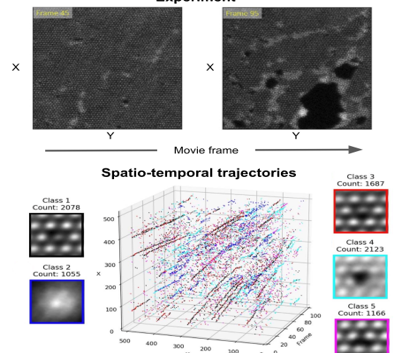
    A robust machine learning method was developed by CNMS, in collaboration with users from the University of Tennessee, to automatically convert STEM movies into atomic positions without any limitation on data volume.

1
2