News

Showing 10 results for Researcher: Chengyun Hua

  • ORNL Placeholder Image

    May 4, 2026

    1 MIN READ

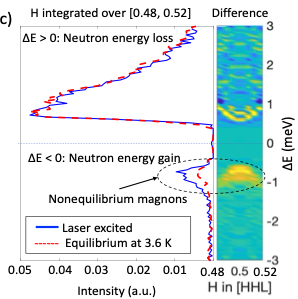
    Scientific Achievement: Laser pumping combined with inelastic neutron scattering reveals long-living nonequilibrium magnons in a 2D Heisenberg antiferromagnet that break detailed balance in the structure factor and form steady states under periodic driving, analogous to driven dissipative nonequilibrium systems.Significance and Impact: This work opens a previously unexplored frontier: momentum- and energy-resolved studies of dissipative quantum dynamics at milli-electron-volt energy and microsecond time scales.DOI: 10.1038/s41467-026-71068-w

  • ORNL Placeholder Image

    January 20, 2026

    4 MIN READ

    Three researchers at Oak Ridge National Laboratory have been recognized with Department of Energy Office of Science Early Career Research awards for innovative work in quantum materials, data visualization, and neutron imaging, advancing understanding of fundamental science and enabling new technologies.

  • ORNL Placeholder Image

    March 4, 2025

    3 MIN READ

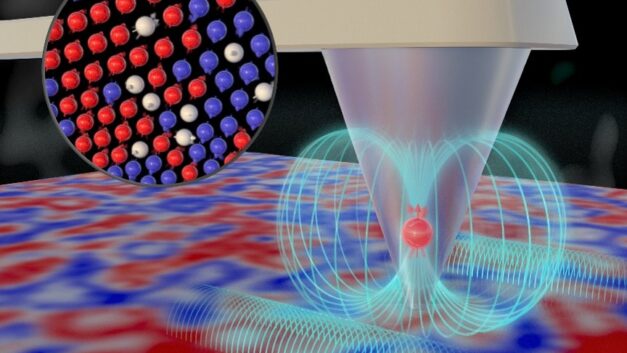
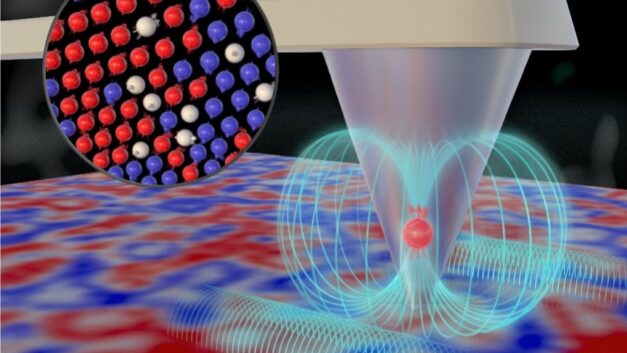
    Working at nanoscale dimensions, billionths of a meter in size, a team of scientists led by ORNL revealed a new way to measure high-speed fluctuations in magnetic materials. Knowledge obtained by these new measurements could be used to advance technologies ranging from traditional computing to the emerging field of quantum computing.

  • ORNL Placeholder Image

    February 3, 2025

    1 MIN READ

    Scientific Achievement: Hidden spin fluctuations in a room-temperature ferromagnet consistent with three-dimensional spin interactions were unveiled by NV magnetometry and relaxometry.Significance and Impact: The power-law scaling observed in the magnetic texture of Sr2FeReO6 provides new opportunities to understand how local spin-fluctuations become correlated near quantum and classical phase transitions.DOI: 10.1021/acs.nanolett.4c05401

  • ORNL Placeholder Image

    April 30, 2024

    3 MIN READ

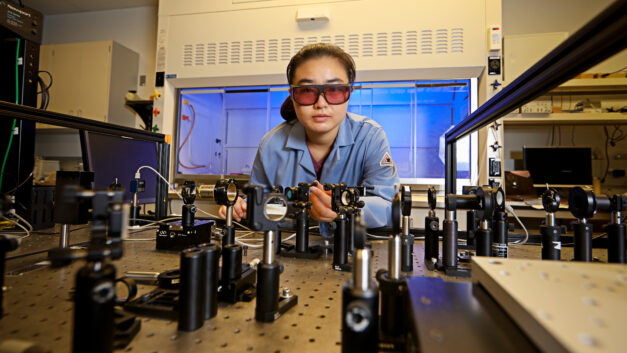
    The Quantum Voices series is designed to share the stories of the quantum researchers and technical experts behind the Quantum Science Center’s past, present and future accomplishments. Chengyun Hua is highlighted for this edition, talking about her role in the Quantum Science Center.

  • ORNL Placeholder Image

    March 22, 2023

    1 MIN READ

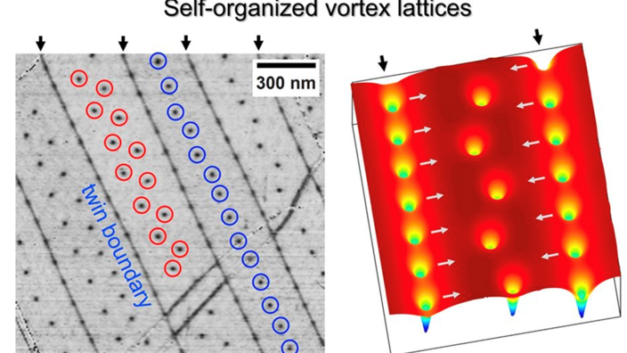
    Scientific Achievement: Twin boundaries in FeSe preferentially attract superconducting vortices. The resulting incommensurate potential produces regular 2D and 1D vortex lattices, precisely variable intervortex distance, and profound geometric size effects.Significance and Impact: Control over vortex interactions is crucial to quantum information devices. Our findings open an intrinsic path to control of vortex geometry, bypassing damaging lithography in favor of topological defects and self-organization.DOI: 10.1021/acs.nanolett.3c00125

  • ORNL Placeholder Image

    July 31, 2020

    1 MIN READ

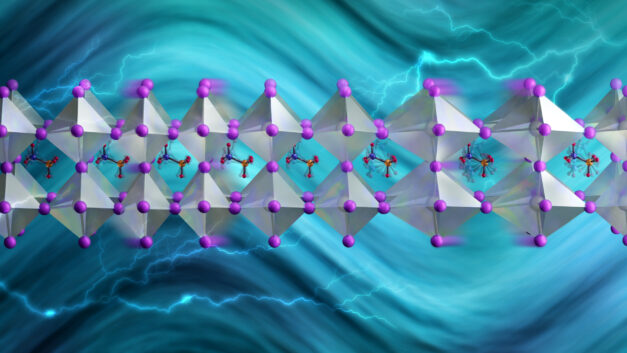
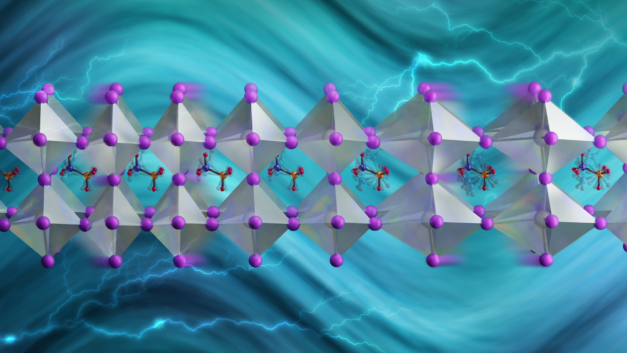
    Scientific Achievement: Neutron scattering from photovoltaic methylammonium lead iodide reveals a giant effect of isotopic substitution on phonons due to coupling with molecule dynamics that results in enhanced thermal resistivity and increased hot-carrier cooling times.Significance and Impact: This route for keeping charge carriers hot longer bares new strategies for achieving record solar-to-electric conversion efficiency in novel hot carrier solar cells.DOI: 10.1126/sciadv.aaz1842

  • ORNL Placeholder Image

    October 13, 2017

    5 MIN READ

    In Chengyun Hua’s research, everything revolves around heat and how it moves. As a Russell Fellow at the Department of Energy's Oak Ridge National Laboratory, Hua carefully analyzes nanoscale heat transfer mechanisms using laser spectroscopy. “Heat is being generated from every...

  • ORNL Placeholder Image

    August 16, 2017

    4 MIN READ

    In Chengyun Hua’s research, everything revolves around heat and how it moves. As a Russell Fellow in ORNL’s Building Equipment Research Group, Chengyun carefully analyzes nanoscale heat transfer mechanisms using laser spectroscopy. “Heat is being generated from everywhere and we can collect that ...