
Scientific Achievement
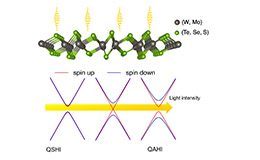
Theoretical predictions show that circularly polarized light can induce the quantum anomalous Hall effect in 1T’ transition metal dichalcogenides (TMDs).
Significance and Impact
The quantum anomalous Hall effect offers a route to topological superconductivity with potential applications in quantum computing. More generally, our study provides a new platform to investigate the out-of-equilibrium physics of light-matter interactions.
Research Details
–Investigated light-induced topological phase transitions in 1T’ TMD monolayers using first-principles calculations.
–Predicted that upon irradiation, 1T’-WSe2, 1T’-MoSe2, and 1T’-WS2 spin-Hall insulators undergo a topological transition to quantum anomalous Hall insulators.
–Furthermore, calculations show that light can create quantum spin Hall band gaps up to 92.5 meV in 1T’-WTe2 and 1T’-MoTe2.
X. Kong, W. Luo, L. Li, M. Yoon, T. Berlijn, and L. Liang. 2D Materials, 9 025005 (2022). DOI: 10.1088/2053-1583/ac4957
Related Researchers