Simulations Demonstrate How Superconductivity Disappears at the Overdoped End of the Cuprate Phase Diagram
1 MIN READ

Simulations Demonstrate How Superconductivity Disappears at the Overdoped End of the Cuprate Phase Diagram

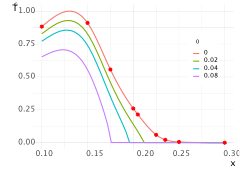
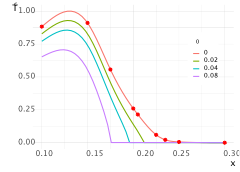
Superconducting transition chart
Superconducting transition temperature Tc versus hole doping x of the 2D Hubbard model in the overdoped region: For the pure system (red dots and line), Tc vanishes with an essential exponential singularity. Impurity scattering (curves with finite Γ0) changes the exponential tail to a more abrupt end, consistent with experimental observations.

Scientific Achievement: Quantum Monte Carlo simulations of a two-dimensional Hubbard model reveal that the combined effects of a decreasing spin-fluctuation pairing interaction and weak impurity scattering lead to the abrupt overdoped end of the superconducting dome.

Significance and Impact: Results provide new insight into the nature of the pairing mechanism that leads to superconductivity in the cuprate materials.

DOI: 10.1103/PhysRevResearch.2.033132

Related Researchers


Media Contacts