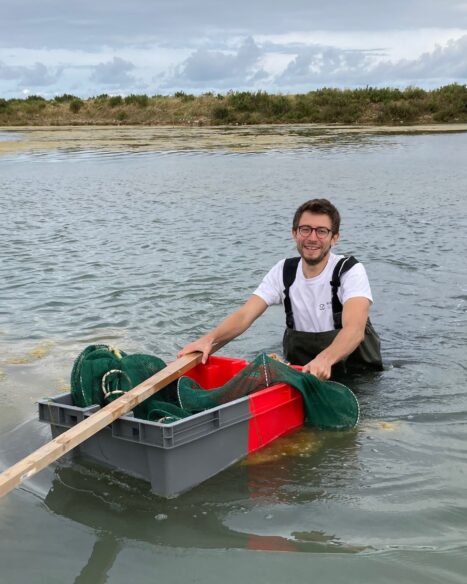
Antoine Minet is a researcher in the field of ecotoxicology, with a specialized focus on the interactions between environmental stressors and aquatic organisms. He holds a PhD in Physiology, Organism Biology, Populations, and Interactions from La Rochelle University in France, where he also served as a teaching and research assistant.
Throughout his career, Antoine has dedicated himself to understanding the impact of pollutants, such as mercury, plastics, nanoparticles and pharmaceuticals on diverse biological systems ranging from bacteria to top predator. His doctoral research focused on the bioaccumulation and effects of mercury in the common cuttlefish Sepia officinalis, under conditions of ocean acidification. His work at the International Atomic Energy Agency in Monaco and La Rochelle University allowed him to master techniques using stable and radioactive isotopes. Antoine has acquired extensive expertise in ethology during his time at the marine station in Luc sur Mer, where he honed his skills in animal behavior studies. Furthermore, he has developed considerable expertise in the use of micro-mesocosms to study the ecotoxic effects of contaminants on aquatic organisms.
Currently, Antoine is a Postdoctoral Research Associate working on Mercury. Mercury is one of the most pervasive and widespread contaminants worldwide but the relationship between environmental mercury concentrations, methylmercury production, and mercury bioaccumulation is poorly understood. Because methylmercury bioaccumulation in fish poses both a human health and ecological risk, there is a need to understand both the chemical and ecological drivers of mercury bioaccumulation in aquatic systems. In particular, Antoine examines the effects of filter feeders on mercury dynamics in stream systems. As keystone species in freshwater ecosystems, freshwater bivalves can drastically affect water quality, habitat, and food web structures, and consequently their presence may also affect mercury bioaccumulation and trophic transfer.
Beyond the laboratory, Antoine is committed to science education and public engagement, having organized several events aimed at demystifying scientific research to a broader audience. He is also an advocate for diversity, equity, and gender equality in the scientific community, embodying these values in his everyday professional interactions.