
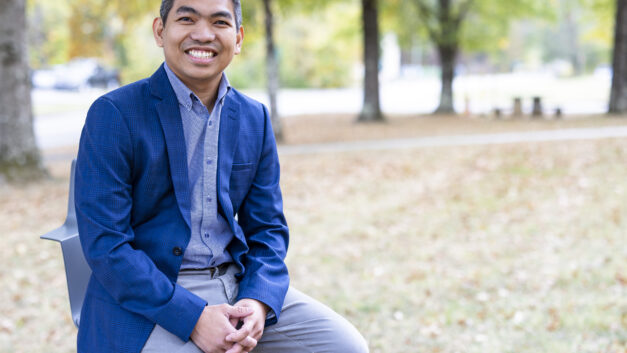
Christian Mark G. Salvador, Ph.D. is an atmospheric scientist in the Environmental Sciences Division, where he leads research at the intersection of atmospheric chemistry, microbiological and vegetation activities, aerosol science, climate feedbacks, and environmental mass spectrometry. His work focuses on understanding how volatile organic compounds (VOCs) from natural and anthropogenic sources transform into atmospheric aerosols that influence air quality, radiative forcing, cloud processes, and human exposure. By integrating field observations, laboratory experiments, and high-resolution chemical analysis, Dr. Salvador develops mechanistic insights into how environmental stressors such as extreme heat, wildfire emissions, urbanization, and future climate conditions alter atmospheric composition and aerosol formation pathways.
At ORNL, Dr. Salvador serves as Principal Investigator for multiple atmospheric chemistry and climate research initiatives, including studies investigating the impacts of future climate scenarios on aerosol formation and the atmospheric degradation of emerging low-global-warming-potential refrigerants. He also leads the Mixed Precursor and Future Climate Scenarios in the Southeastern U.S. (MPFCS) project, which examines how interacting biogenic and anthropogenic emissions influence aerosol and cloud formation under real-world environmental conditions. His recent work has demonstrated that extreme heat and wildfire emissions substantially enhance VOC concentrations in temperate forest ecosystems, providing new insights into climate-sensitive atmospheric feedback mechanisms in the southeastern United States. His research further advances understanding of urban atmospheric dynamics through investigations linking atmospheric gases and particulate matter with urban heat island intensity and land-use gradients
Dr. Salvador is also the lead scientist and instrument manager for ORNL’s Proton-Transfer-Reaction Time-of-Flight Mass Spectrometry (PTR-ToF-MS) systems, where he develops advanced analytical and automation capabilities for real-time characterization of trace gases and aerosols. His expertise in high-resolution mass spectrometry spans atmospheric chemistry, environmental exposure science, and nuclear analytical applications. Recent studies led and co-authored by Dr. Salvador include characterization of VOC enhancements during wildfire and heat events, development of atmospheric transformation pathways of refrigerants, quantification of atmospheric indicators of urbanization, and identification of intermediates formed during UF₆ hydrolysis relevant to nuclear forensics. His research portfolio combines fundamental atmospheric science with applied environmental and national security challenges, strengthening ORNL’s capabilities in environmental monitoring, aerosol analytics, and climate-related research.
Links
- ORCID
- Google Scholar
- Atmospheric and Soil Parameters in Five Urban Sites in Knoxville, Tennessee, 2024
- SPRUCE Atmospheric Gas and Aerosol Particle Concentrations, 2023-2024
- Meteorological Conditions and Atmospheric Components Concentration in Urban Sites in Knoxville, USA. 2024
- Volatile Organic Compounds Meteorological Conditions in the Missouri Ozark AmeriFlux (MOFLUX) Site, 2023
Publications
Jan, 2026
ORNL Report
Atmospheric Gases as Quantitative Indicators of Urbanization Across Land-Use Gradients
News
November 14, 2023
8 MIN READ
Air quality control: Understanding atmospheric pollutants with Christian Salvador