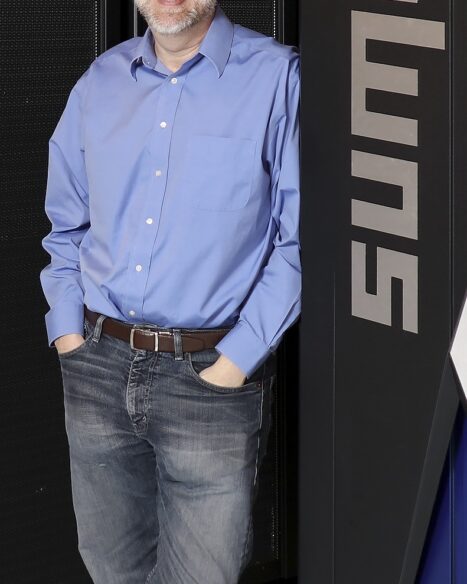
We are happy to be the first group to break the Exascale barrier and to have done it for biology. This project led to us winning the 2018 Gordon Bell Prize (the first ever for Systems Biology). At present, our latest 9.37 Exaflops mixed precision calculation is the fastest scientific calculation ever done anywhere in the world.
https://www.energy.gov/articles/doe-laboratories-win-gordon-bell-prize
My team focuses on the development and subsequent application of mathematical, statistical and computational methods to biological datasets in order to yield new insights into complex biological systems. Our approaches include the use of Network Theory and Topology Discovery/Clustering, Wavelet Theory, Machine & Deep Learning (amongst others: iterative Random Forests, Deep Neural Networks, etc.) and Linear Algebra (primarily as applied to large-scale multivariate modeling), together with traditional and more advanced computing architectures, such as MPI parallelization. We make use of various programming languages including C, Python, Perl, and R. Areas of Statistics of particular interest to my lab include the use of both frequentist (parametric and non-parametric) and Bayesian methods as well as the development of new methods for Genome-Wide Association Studies (GWAS) and Phenome-Wide Associations Studies (PheWAS). These mathematical and statistical methods are applied to various population and (meta)multiomics data sets (Genomics, Phylogenomics, Transcriptomics, Proteomics, Metabolomics, Microbiomics, Viriomics, Phytobiomics, Chemiomics, etc.) individually as well as in combination in an attempt to better understand the functional relationships as well as biosynthesis, signaling, transcriptional, translational, degradation and kinetic regulatory networks at play in biological organisms and communities.
Many of our projects center around studying systems in involved the Center for Bioenergy Innovation (CBI), Plant-Microbial Interfaces (PMI) and Secure Ecosystem Engineering and Design (SEED) programs at ORNL. However, we have a broad view of biological complexity and evolution that stretches from viruses to microbes to plants to humans (including cancer and neuroscience) which is reflected by a broad funding portfolio from DOE, NIH, NSF, VA and other sources.
ORNL is home to some of the world’s largest supercomputers. My team uses petascale and exascale computing to analyze and model complex biological systems. Thus, there are excellent opportunities to be involved in the cutting edge of computational systems biology and supercomputing.
As interdisciplinary and multidisciplinary efforts are more and more critical for scientific discovery, we do maintain a wide network of collaborations from all around the world.
Links
Publications
News
February 26, 2026
3 MIN READ
Researchers harness synthetic biology to power the biofactories of the future