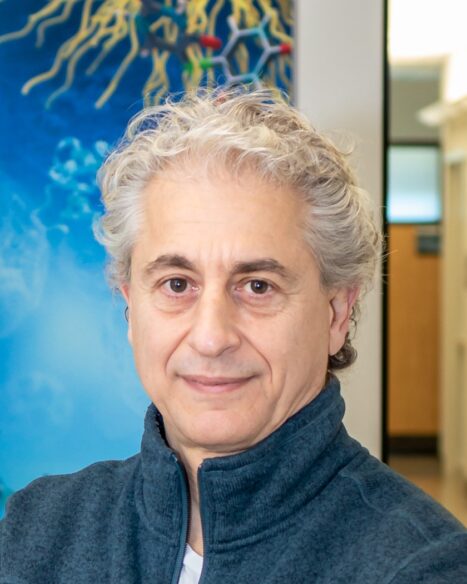
John joined ORNL as Distinguished R&D staff for Biological Systems and is currently leading the Soft Matter Sample Environments effort in Neutron Scattering Division.
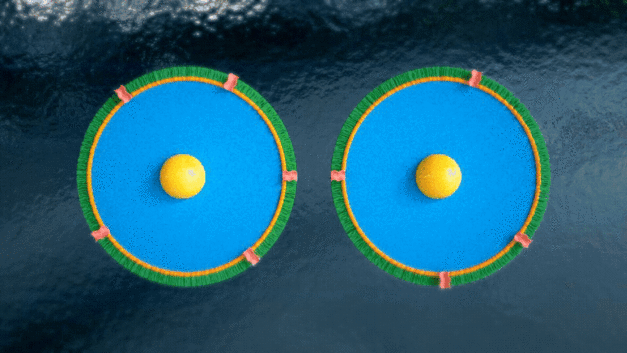
John has a broad academic background that has enabled him to develop, lead, collaborate, and successfully conduct interdisciplinary research for the past 35 years using different scattering (light, x-rays, and neutrons) and biophysical (calorimetry, spectroscopies) techniques, combined with computer simulations. Over the past 25 years, John ,with his students and colleagues, has developed neutron scattering models to analyze neutron scattering data and experimental approaches to detect nanoscopic lipid domains. Starting in 2020, John and his collaborators have been studying lipid bilayers as potential neuromorphic platforms which exhibit persistent synaptic plasticity in the form of long-term potentiation (LTP), a feature associated with learning and memory.
Since 1998, John has supervised numerous postdoctoral students who have gone on to have significant scientific careers of their own as professors at universities and staff scientists/directors at national labs/government agencies, and who are known, both nationally and internationally, for their own scientific contributions and achievements. He has presented over 200 invited talks (16 plenary/keynote lectures) and reviewed for a wide range of journals and scientific organizations. Currently, he is associate editor for Chemistry and Physics of Lipids and on the editorial board of Biochimica et Biophysica Acta – Biomembranes and Membranes. John is fellow of the Neutron Scattering Society of America (NSSA) and the American Institute for Medical and Biological Engineering. In 2022, John was the recipient of NSSA’s Sustained Research Prize.