News

Showing 6 results for Researcher: Xiao Wang

  • ORNL Placeholder Image

    January 28, 2026

    7 MIN READ

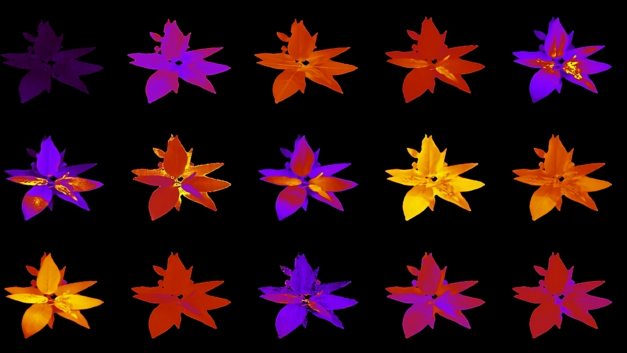
    Scientists at ORNL have created a new method that more than doubles computer processing speeds while using 75 percent less memory to analyze plant imaging data. The advance removes a major computational bottleneck and accelerates AI-guided discoveries for the development of high-performing crops.

  • ORNL Placeholder Image

    May 7, 2025

    6 MIN READ

    Research teams at the Department of Energy’s Oak Ridge National Laboratory received computing resource awards to train and test AI foundation models for science. A total of six ORNL projects were awarded allocations from the National Artificial Intelligence Research Resource, or NAIRR, pilot and the Innovative and Novel Computational Impact on Theory and Experiment, or INCITE, program to train their AI models.

  • ORNL Placeholder Image

    November 13, 2024

    7 MIN READ

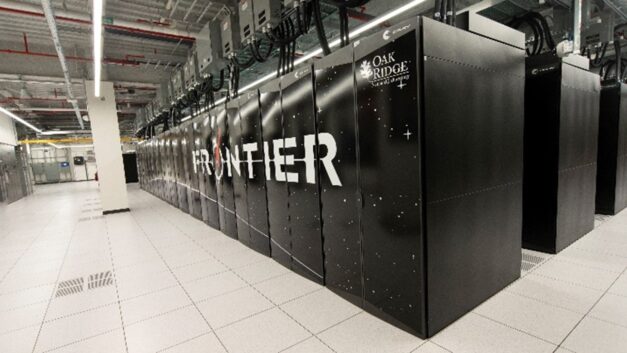
    Researchers at Oak Ridge National Laboratory used the Frontier supercomputer to train the world’s largest AI model for weather prediction, paving the way for hyperlocal, ultra-accurate forecasts. This achievement earned them a finalist nomination for the prestigious Gordon Bell Prize for Climate Modeling.

  • ORNL Placeholder Image

    April 12, 2023

    3 MIN READ

    Xiao Wang, a research scientist at ORNL, has been named a senior member of the Institute of Electrical and Electronics Engineers, the world’s largest organization for technical professionals. Wang works in the lab’s Computing and Computational Sciences Directorate’s Advanced Computing for Health Sciences Section.

  • ORNL Placeholder Image

    May 25, 2022

    2 MIN READ

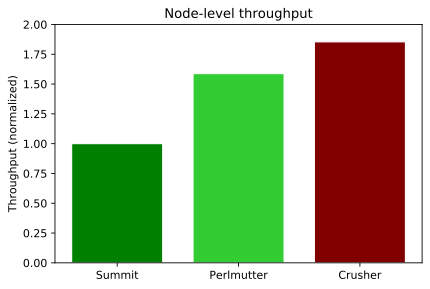
    Transformer language models provide state-of-the-art accuracy in a range of learning tasks, ranging from natural language processing to non-traditional applications such as molecular design. For domain-specific applications like clinical text or molecular design, Transformer models must be 'pre-trained' on a very large, domain-relevant data corpus. However, this pre-training procedure is very computationally intensive, requiring significant GPU compute. For instance, the pre-training of a Transformer for molecular design was the subject of our 2021 COVID-19 Gordon Bell finalist (see Andrew Blanchard's slide). Consequently, being able to efficiently train and scale these models on Frontier will be cricial. We've been working to port and optimize large Transformer libraries, such as Megatron and DeepSpeed, to Crusher and the Frontier node architecture. We're currently seeing a 1.8-1.85x speedup for a Crusher node versus a Frontier node. As a roofline model for FP16 ops predicts a 2.25x speedup, we think this is an encouraging result.